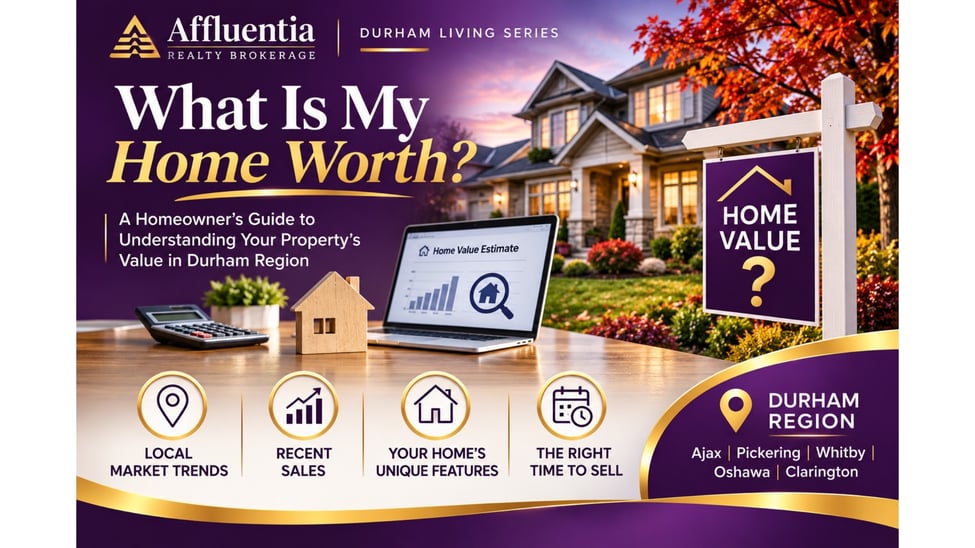
"How much is my home worth?" is the question I hear more than any other from homeowners in Ajax, Whitby, Oshawa and across Clarington. Sometimes you're thinking about selling, sometimes you're planning a move up, and sometimes you're simply curious whether your biggest asset has grown. 🏡 Whatever the reason, the honest answer is the same: your home is worth what a well-informed buyer will pay for it in today's market, and that number comes from real local sales, not a guess.
Before real estate, I spent years in banking, so I like to start every value conversation with the numbers. In this guide I'll walk you through what Durham homes are actually selling for right now, why online estimates and your property tax assessment can mislead you, and how a proper home valuation is built.
What Durham Region homes are selling for right now (October 2026)
According to TRREB's Market Watch for October 2026, Durham Region recorded 589 sales at an average price of $793,024 and a median price of $740,000 across all home types. Detached homes in Durham averaged $875,260. On average, homes sold for 98% of their final list price and spent 29 days on the market.
Prices vary quite a bit from town to town:
Average sale price by Durham municipality, October 2026
Source: TRREB Market Watch, October 2026 (all home types)
| Municipality | Sales | Average price | Median price | Sale-to-list |
|---|---|---|---|---|
| Ajax | 74 | $918,704 | $812,750 | 97% |
| Whitby | 108 | $876,275 | $852,500 | 98% |
| Pickering | 93 | $821,211 | $784,990 | 98% |
| Clarington | 111 | $742,452 | $680,000 | 99% |
| Oshawa | 152 | $653,466 | $623,750 | 98% |
| Durham Region | 589 | $793,024 | $740,000 | 98% |
One important caution: these are averages across all home types. A month where more condos sell in Pickering, or more detached homes sell in Whitby, can move the average without any individual home changing in value. That's exactly why the average for your town is a starting point, not your number.
Why your home's value isn't the town average
Two homes on the same Courtice street can sell tens of thousands of dollars apart. The things that really move value include:
- Property type and size: detached, semi, freehold town or condo town, plus finished square footage and lot frontage.
- Bedrooms and bathrooms: a fourth bedroom or a second full bath often matters more to Durham families than a fancy finish.
- Micro-location: walking distance to a GO station in Ajax, Whitby or Oshawa, school catchments in Brooklin, backing onto green space versus a busy road.
- Condition and updates: roof, furnace, windows and kitchen age. Buyers price in what they'll have to replace.
- Income potential: a legal or well-built basement suite can widen your buyer pool to include investors.
- Market timing and competition: how many similar homes are listed nearby the week you hit the market.
Online estimates vs. your MPAC assessment vs. market value
Most homeowners have seen at least one of these numbers. Here's why none of them should be treated as your sale price:
- Online "instant" estimates rely on algorithms and public data. They usually can't see your renovated kitchen, your new roof, or the fact that the house backing onto the 401 sold for less than yours would.
- Your MPAC property assessment is used to calculate property taxes, not sale prices. MPAC confirms that Ontario assessments for the 2026 tax year continue to be based on January 1, 2016 current values, so the figure on your notice can be far from today's market. (If you're curious how taxes compare across towns, see our post Durham Region Property Taxes 2026.)
- Market value is what a willing buyer pays a willing seller today, and the best evidence for it is recent, comparable sales near you.
How a professional home valuation is built 📊
When I prepare a home value assessment, I build what's called a comparative market analysis (CMA). Here's what goes into it:
- Recent sold comparables: homes similar to yours that sold nearby, ideally in the last few months. Sold prices matter far more than asking prices.
- Active and expired listings: active listings are your competition; expired ones show where buyers said "no".
- Adjustments: a dollar adjustment for differences like a garage, an extra bathroom, lot size or a finished basement.
- Market pace: sale-to-list ratios and days on market tell us whether there's room to push or whether pricing sharply is the safer play.
- A walk-through: nothing replaces seeing the home. Condition and layout are where the algorithms fall short.
The output isn't a single magic number. It's a realistic price range, plus a recommended list price strategy for the market we're in.
What today's market pace tells Durham sellers
Days on market are a useful reality check. In October 2026, Durham homes averaged 29 days from listing to sale, with Clarington moving fastest of the five main towns:
Average days on market (LDOM), October 2026
Source: TRREB Market Watch, October 2026 (all home types)
Durham had 2,619 active listings and about 3.6 months of inventory in October, which means buyers have choices. In this kind of market, a home that's priced in line with its comparables tends to attract showings early, while an overpriced home risks sitting and eventually selling for less. With an average 98% sale-to-list ratio, a home listed at $800,000 would, on average, sell around $784,000. That's useful context when you're comparing a value estimate to what you'll actually net.
How to get an accurate number for your home
If you want a value you can actually plan around, here's what I'd suggest:
- Gather your upgrade list with approximate dates and costs (roof, furnace, windows, kitchen, baths).
- Note anything unique: a lot backing onto a ravine, a separate side entrance, a large garage.
- Look at sold prices, not asking prices, for homes like yours in your neighbourhood.
- Ask for a written CMA from a local agent who walks through the home, and ask them to explain each comparable they used.
- Think about your next step at the same time. Your sale price only means something once you know what you're buying next and what it'll cost to sell.
How we approach this: The Affluentia Way
Every client I work with goes through the same four-stage plan we call The Affluentia Way:
- Clarity: we start with your numbers: a realistic value range from recent comparables, your mortgage balance, and what you'd net after selling, so you understand your options and goals.
- Positioning: we decide on pricing strategy, timing and preparation so your home stands out against the competing listings buyers are comparing it to.
- Execution: we carry out the plan, from launch and showings to negotiating offers and getting you to closing.
- Expansion: we look at what your equity makes possible next, whether that's a move-up home, a second property or the start of a portfolio.
Curious what your home is worth? Let's talk 🔑
If you own a home in Ajax, Whitby, Oshawa, Pickering, Clarington or anywhere in Durham Region, I'd be happy to prepare a no-pressure home value assessment based on real local sales. You'll get a clear price range and an honest view of what selling could look like, whether you're moving next month or next year.
👉 Book a 30-minute home value conversation or call me at 647.282.8078.
Neeraj Khanna, Broker of Record, Affluentia Realty
This article is general information only and is not tax, legal or financial advice. Market figures are from TRREB Market Watch, October 2026, and MPAC; they reflect averages and may not reflect the value of any specific property. Please consult a qualified professional about your own situation.