Almost every investor I sit down with in Durham Region eventually asks me the same question: "Neeraj, should I buy for cash flow or for appreciation?" 🏡 It's a great question, and as a former banker I love it, because the honest answer lives in the numbers, not in a slogan. In this guide I'll walk you through what cash flow and appreciation really mean, run two real-number examples using the latest TRREB data for Oshawa and Ajax, and show you how to decide which strategy fits your goals.
Cash Flow vs Appreciation: The Quick Definitions
Cash flow is the money left over each month after the rent comes in and every expense goes out: mortgage, property tax, insurance, maintenance and an allowance for vacancy. Positive cash flow pays you today.
Appreciation is the increase in the property's value over time. You don't feel it month to month, but you capture it when you sell or refinance.
There's a third piece most people forget: principal paydown. Every mortgage payment your tenant helps cover reduces your loan balance, which builds equity even when prices are flat. When I look at a Durham rental, I always look at all three together.
What Durham's Numbers Look Like Right Now
According to TRREB's Market Watch for October 2026, the average price across Durham Region was $793,024 on 589 sales, and the MLS® HPI composite benchmark was $798,100, down 5.11% year over year. Prices vary a lot by town:
- Oshawa: $653,466 average (152 sales)
- Clarington (Bowmanville, Courtice): $742,452 average
- Pickering: $821,211 average
- Whitby: $876,275 average
- Ajax: $918,704 average
On the rent side, Rentals.ca's November 2026 National Rent Report (October data) puts Oshawa's average asking rent at $1,710 for a one-bedroom and $2,015 for a two-bedroom. Ajax came in at $1,932 and $2,285. Financing matters just as much: on November 18, 2026, nesto listed a 5-year fixed uninsured rate of 4.95%, and rental properties often price a little higher than that.
A Lesson From the Last Ten Years 📈📉
Appreciation is real, but it isn't a straight line. Here's Durham's average price at three points in time, straight from TRREB's Market Watch reports:
Durham Region Average Sale Price
Source: TRREB Market Watch (October 2016, March 2022, October 2026), November 2026
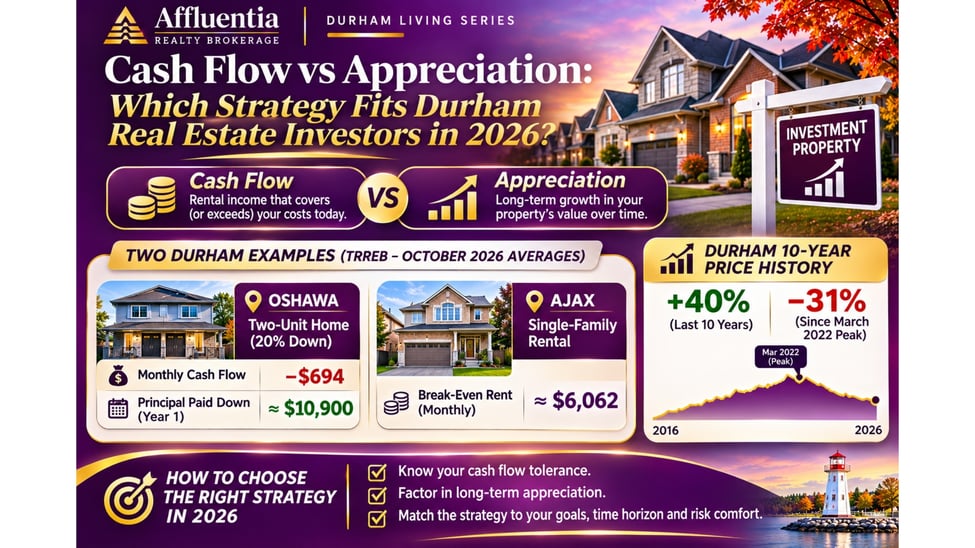
Over ten years, Durham's average price rose about 40%, roughly 3.45% a year compounded. But someone who bought at the March 2022 peak is still looking at an average about 31% lower today. Appreciation rewarded patient owners; it punished anyone who needed to sell at the wrong time. That's why I never build an investment plan that only works if prices go up.
Example 1: A Two-Unit Home in Oshawa (Cash-Flow Leaning)
Let's say you buy at Oshawa's October average of $653,466, with a legal two-unit setup: a two-bedroom upstairs and a one-bedroom downstairs, each rented at Oshawa's average asking rent. You put 20% down ($130,693) and borrow $522,773 at 4.95% over 25 years. Oshawa's 2026 residential tax rate is 1.575342%.
| Monthly item | Amount |
|---|---|
| Rent (2-bed $2,015 + 1-bed $1,710) | $3,725 |
| Mortgage payment | −$3,026 |
| Property tax | −$858 |
| Insurance (assumption) | −$200 |
| Maintenance (assumed 5% of rent) | −$186 |
| Vacancy (assumed 4% of rent) | −$149 |
| Monthly cash flow | −$694 |
Oshawa Two-Unit Example: Rent vs Monthly Costs
Source: TRREB Market Watch, Rentals.ca, City of Oshawa, nesto rate (insurance, maintenance and vacancy are assumptions), November 2026
Even with two units at today's 20%-down financing, this example runs about $694 a month negative. But look at the full picture for year one:
- Cash flow: about −$8,328 for the year
- Principal paydown: about +$10,936 of loan repaid
- Net before any price change: roughly +$2,608 in equity
- Price sensitivity: every 1% move in value is about ±$6,535
To break even monthly at these numbers, you'd need roughly 38% down (about $250,500). That's not a reason to avoid Oshawa; it's a reason to know your numbers before you write an offer.
Example 2: A Detached Home in Ajax (Appreciation Leaning)
Now take Ajax's October average of $918,704 as a single-family rental. With 20% down ($183,741) at the same 4.95%, the mortgage is about $4,254 a month. Add Ajax's 2026 residential tax rate of 1.388664% (about $1,063 a month), $200 for insurance, and the same maintenance and vacancy allowances, and you'd need rent of roughly $6,062 a month just to break even.
That's well above what most single-family homes in Durham rent for, so a buyer here is really betting on long-term appreciation and principal paydown (about $15,375 in year one). It can absolutely work for someone with a long time horizon, strong income to carry the shortfall, and no need to sell in a soft market. It's a poor fit for someone who needs the property to pay its own way.
How to Decide Which Strategy Fits You
Here's how I help clients think about it:
- Lean toward cash flow if you want income now, have limited reserves, or plan to grow a portfolio and need each property to qualify on its own. In Durham, that usually means Oshawa or Clarington, legal second units, duplexes, and more cash down.
- Lean toward appreciation if you have a 10+ year horizon, stable income to cover a monthly gap, and want quality locations in Ajax, Whitby or Pickering.
- Blend both by living in one unit and renting the other. Your tenant helps pay the mortgage while you build equity, which is exactly how many of my clients turn their first home into property number one of a portfolio.
Two rent rules matter for your cash-flow math. Ontario's rent increase guideline for 2027 is 1.9% for units it applies to, and units first occupied as residences after November 15, 2018 are generally exempt from the guideline. Check with the Landlord and Tenant Board or a real estate lawyer before you count on any increase, and speak with an accountant about how rental income and expenses are taxed.
How we approach this: The Affluentia Way
Every client I work with goes through the same four-stage plan we call The Affluentia Way:
- Clarity: We map your numbers, reserves, time horizon and goals, so you know whether cash flow, appreciation or a blend makes sense for you.
- Positioning: We line up financing, run the rent and expense math on real listings, and target the Durham towns and property types that fit your strategy.
- Execution: We find the right property, negotiate, and carry the plan through to closing.
- Expansion: Once it's performing, we look at your equity and cash flow together to plan the next property or bigger goal.
Let's Run Your Numbers Together
Every investor's situation is different, and a few hundred dollars a month in either direction can change the whole plan. If you'd like me to run cash flow and appreciation scenarios on a property you're considering in Ajax, Whitby, Oshawa, Bowmanville or anywhere in Durham, book a 30-minute call with me or call me directly at 647.282.8078. 📞
Neeraj Khanna, Broker of Record, Affluentia Realty
This article is general information only and is not tax, legal or financial advice. Examples use October 2026 averages and stated assumptions and are illustrations, not projections. Please consult a qualified accountant, lawyer and mortgage professional before making investment decisions.