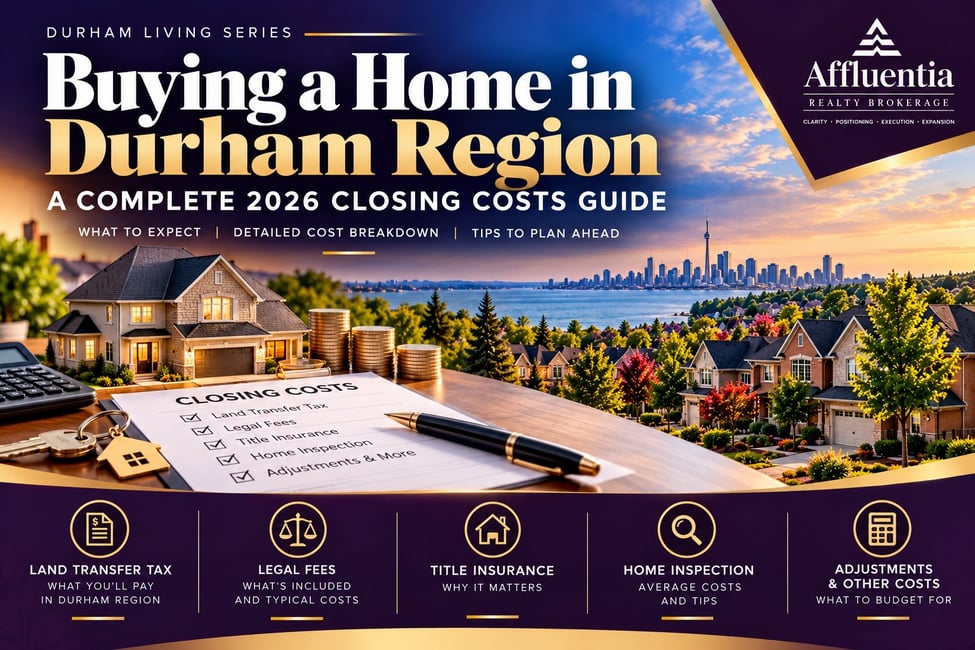
Buying a Home in Durham Region: A Complete 2026 Closing Costs Guide
Land Transfer Tax, Legal Fees, Title Insurance, Home Inspections and the Hidden Expenses Every Buyer Should Know
Durham Living Series | Affluentia Realty, Brokerage
You've found the perfect home in Durham Region. The price fits your budget, the neighbourhood feels right, and your mortgage pre-approval is in place.
But there's one question many homebuyers overlook until they're approaching their closing date:
How much money do I actually need to close on my home?
The purchase price is only part of the equation.
Whether you're buying your first townhouse in Oshawa, upgrading to a detached home in Whitby, relocating from Toronto to Ajax, or purchasing a new construction property in Clarington, there are additional expenses that must be considered.
These are known as closing costs.
And while some expenses are relatively predictable, others depend on your property, financing arrangements, and the terms of your purchase agreement.
In this guide, we'll break down the major closing costs associated with buying a home in Durham Region in 2026, explain which expenses are mandatory, and show you how to budget for your purchase without unpleasant surprises.
1. What Are Closing Costs When Buying a Home?
Closing costs are the additional expenses associated with completing a real estate transaction.
They are generally paid before or on the closing date, when legal ownership of the property transfers to the buyer.
Some costs are government-imposed, such as land transfer tax. Others involve professional services, insurance, inspections, or adjustments between the buyer and seller.
Common closing expenses include:
Ontario land transfer tax.
Real estate lawyer's fees and disbursements.
Title insurance.
Home inspection fees.
Appraisal fees, where required.
Property tax and utility adjustments.
Mortgage-related expenses.
Condominium status certificate review, where applicable.
New construction adjustments and applicable taxes.
Moving and immediate occupancy expenses.
Not every buyer will incur every expense.
For example, a cash buyer may not need a lender's appraisal, while a purchaser of a condominium may need to review a status certificate.
The goal is to understand which costs apply to your particular transaction.
2. How Much Should You Budget for Closing Costs in Durham Region?
A commonly used starting point is to budget approximately 1.5% to 4% of the purchase price for closing-related expenses, separate from your down payment.
However, this is a planning guideline, not a fixed rule.
The actual amount can be lower or higher depending on the purchase price, eligibility for land transfer tax rebates, mortgage requirements, property type, and whether the home is a resale or new construction property.
Illustrative closing-cost planning ranges
| Home purchase price | 1.5% estimate | 4% estimate |
|---|---|---|
| $600,000 | $9,000 | $24,000 |
| $700,000 | $10,500 | $28,000 |
| $800,000 | $12,000 | $32,000 |
| $900,000 | $13,500 | $36,000 |
| $1,000,000 | $15,000 | $40,000 |
These figures are general planning allowances, not quotations or required cash amounts.
For an $800,000 resale property, the provincial land transfer tax alone may be $12,475 before any applicable rebate.
That is why a detailed calculation is more useful than relying solely on a percentage.
My recommendation: Before submitting an offer, ask your real estate lawyer and mortgage professional to help estimate the actual closing funds required for your specific purchase.
3. Ontario Land Transfer Tax: Often the Largest Closing Expense
For many buyers, land transfer tax is one of the highest costs payable at closing.
In Ontario, this tax is generally calculated using the value of the consideration for the property, which is usually the purchase price in a conventional transaction.
Durham Region homebuyers are generally subject to Ontario's provincial land transfer tax.
Unlike purchases within the City of Toronto, Durham properties are not subject to Toronto's additional municipal land transfer tax.
Ontario residential land transfer tax rates
For a typical residential purchase involving one or two single-family residences, the provincial rates are:
| Portion of purchase price | Tax rate |
|---|---|
| First $55,000 | 0.5% |
| $55,000.01 to $250,000 | 1.0% |
| $250,000.01 to $400,000 | 1.5% |
| $400,000.01 to $2,000,000 | 2.0% |
| Amount over $2,000,000 | 2.5% |
These are marginal rates, meaning each rate applies only to the corresponding portion of the property's value.
Example: Buying an $800,000 home in Durham Region
Here's how the provincial land transfer tax is calculated:
| Purchase price portion | Tax |
|---|---|
| First $55,000 at 0.5% | $275 |
| Next $195,000 at 1.0% | $1,950 |
| Next $150,000 at 1.5% | $2,250 |
| Remaining $400,000 at 2.0% | $8,000 |
| Total Ontario land transfer tax | $12,475 |
This is before any applicable first-time homebuyer rebate or other exemption.
Durham vs. Toronto: An important closing-cost difference
An eligible conventional $800,000 residential purchase in Toronto would generally incur both provincial and Toronto municipal land transfer taxes.
A comparable purchase in Durham would generally incur only the provincial tax.
That difference can make Durham more attractive from an upfront closing-cost perspective.
However, it should be considered alongside mortgage costs, property taxes, transportation, and other ongoing expenses.
4. First-Time Homebuyer Land Transfer Tax Rebates
If you're buying your first home, you may qualify for Ontario's first-time homebuyer land transfer tax refund.
The maximum provincial refund is currently $4,000 for eligible purchasers.
What does that mean?
For an $800,000 Durham home:
Ontario land transfer tax: $12,475.
Maximum eligible first-time buyer refund: $4,000.
Net provincial land transfer tax: $8,475.
Eligibility requirements apply, including age, occupancy intentions, and prior homeownership history.
Where multiple purchasers are involved, the refund may depend on each purchaser's eligibility and ownership interest.
Buyers should confirm eligibility with their lawyer before including the refund in their closing budget.
What about other first-time buyer programs?
Depending on the property and the purchaser, additional federal or provincial programs may be relevant, including tax credits, registered savings plans and qualifying new-home tax measures.
These programs are separate from the Ontario land transfer tax refund and may have different requirements.
Do not assume that qualifying for one program automatically makes you eligible for another.
5. Legal Fees and Disbursements
A real estate lawyer plays an essential role in completing your purchase.
Your lawyer typically reviews the agreement of purchase and sale, conducts title-related searches, addresses legal requirements, coordinates mortgage documentation, prepares closing paperwork, and arranges the transfer of ownership.
What should you budget?
For a straightforward resale purchase, buyers may use an initial planning allowance of approximately $1,500 to $3,000 or more for legal fees, disbursements and related charges, depending on the transaction and the firm's fee structure.
More complicated purchases may cost more.
Additional expenses may arise from title searches, registrations, software charges, document preparation, mortgage instructions or other services.
Applicable HST should also be considered.
Questions to ask your lawyer
Before retaining a lawyer, ask whether the quotation includes:
Professional legal fees.
HST.
Title searches.
Registration charges.
Mortgage-related legal work.
Title insurance.
Other disbursements.
A detailed quotation is more useful than simply comparing advertised legal fees.
6. Title Insurance: Why It Matters
Title insurance is commonly arranged during Ontario real estate transactions.
It can provide protection against certain covered title-related risks, subject to the policy's terms, conditions and exclusions.
These may include specified title defects, registration problems, fraud-related risks, and other covered issues.
A lender may also require its own title insurance coverage.
How much does title insurance cost?
The premium depends on the property's value, policy type, insurer, and transaction circumstances.
For planning purposes, a straightforward residential transaction may involve a premium of several hundred dollars, although actual quotes can vary.
Ask your lawyer whether title insurance is included in the closing estimate.
Title insurance does not replace a home inspection, property survey where needed, or appropriate legal due diligence.
7. Home Inspection Costs
A home inspection can help buyers better understand the condition of a property before committing to a purchase.
An inspector may assess visible and accessible components such as roofing, foundation, heating, cooling, plumbing, electrical systems, and other building elements.
Typical planning allowance
A buyer might budget approximately $400 to $800 or more for a standard home inspection, depending on the size, age, and complexity of the property.
Specialized inspections may involve additional charges.
Examples include:
Septic inspections.
Well-water testing.
Sewer inspections.
Mould or moisture assessments.
Structural engineering reviews.
Is a home inspection mandatory?
A general home inspection is not automatically mandatory for every Ontario resale purchase.
However, it can be a valuable part of a buyer's due diligence.
The appropriate inspection strategy depends on the property and the terms of the offer.
For rural homes in areas such as Uxbridge, Scugog, or Brock, buyers may need to investigate wells, septic systems, and other property-specific considerations.
8. Mortgage Appraisal Fees
Your mortgage lender may require an appraisal to confirm that the property's value supports the proposed financing.
An appraisal is different from a home inspection.
The appraiser focuses primarily on property valuation for lending purposes, while a home inspector examines accessible physical conditions.
What should you budget?
Where the borrower is responsible for the cost, an appraisal may cost several hundred dollars, potentially more for unusual or complex properties.
Some lenders arrange or absorb the appraisal cost.
Others may require payment by the borrower.
Ask your mortgage professional whether an appraisal is required and who will pay for it.
9. Mortgage Default Insurance: Is It a Closing Cost?
Buyers making a down payment below 20% generally require mortgage default insurance for eligible insured mortgages.
This insurance protects the lender—not the borrower—against certain losses if the mortgage goes into default.
The premium depends on factors such as the loan-to-value ratio and applicable insurance rules.
In many cases, the insurance premium can be added to the mortgage principal.
However, Ontario's retail sales tax on the mortgage default insurance premium is generally payable upfront and cannot be added to the insured mortgage.
This is an expense buyers sometimes overlook.
Illustrative example
Suppose a buyer has a mortgage default insurance premium of $20,000.
At Ontario's 8% retail sales tax rate, the tax would be:
$20,000 × 8% = $1,600
That $1,600 should be included in the buyer's available closing funds.
The $20,000 premium in this example is hypothetical; the actual premium must be calculated based on the buyer's mortgage.
10. Property Tax Adjustments on Closing
When a property changes ownership, the buyer and seller may need to adjust certain prepaid expenses.
Property taxes are a common example.
Suppose the seller has already paid municipal property taxes covering a period after the closing date.
The buyer may need to reimburse the seller for the portion relating to the buyer's ownership period.
Alternatively, if taxes remain unpaid, the adjustment may work in the opposite direction.
These amounts are generally calculated by the lawyers and reflected in the statement of adjustments.
Why this matters in Durham
Property tax bills vary across Pickering, Ajax, Whitby, Oshawa, Clarington and the northern Durham municipalities.
A higher annual tax bill can mean a larger adjustment, depending on the closing date and payment status.
For a detailed municipal comparison, see our article:
Property Taxes Across Durham Region Compared: 2026 Guide for Homebuyers and Homeowners.
11. Condominium Closing Costs and Status Certificates
If you're buying a condominium in Pickering, Ajax, Whitby, or Oshawa, there are additional considerations.
A condominium status certificate provides important information about the condominium corporation, including financial and legal matters.
Your lawyer should review the status certificate and accompanying documents as part of the purchase process.
Potential condominium-related expenses
These may include:
Status certificate charges.
Legal review.
Adjustments for prepaid condominium fees.
Applicable move-in or administrative charges.
Other property-specific requirements.
In Ontario, the prescribed fee for a condominium status certificate is generally $100, including applicable taxes, although other document or service charges may arise in certain circumstances.
Buyers should also investigate the condominium corporation's reserve fund, budget, common expenses, and any disclosed special assessments or litigation.
A low monthly condominium fee does not necessarily mean a lower-risk property.
12. New Construction Homes: Additional Costs Buyers Often Miss
Purchasing a new construction home can involve different closing expenses from buying a resale property.
This is particularly important in growing communities across Seaton, Whitby, Oshawa and Clarington.
Development charges and levies
Some new-home agreements permit the builder to pass through certain development-related charges or adjustments.
The amounts and whether they are capped depend on the agreement and applicable law.
Buyers should have their lawyer review these clauses carefully.
Utility and service connection charges
Depending on the agreement, additional charges may apply for utility connections, meters, installations or other services.
HST and rebates
Newly constructed residential properties may be subject to HST.
Builder pricing sometimes assumes that the purchaser qualifies for specified rebates and assigns those rebates to the builder.
Eligibility and the treatment of rebates depend on the property, intended use, transaction date and applicable tax rules.
Federal and Ontario new-home tax measures have changed in recent years, making it particularly important to obtain current advice before signing an agreement.
Occupancy fees for condominiums
Some new condominium purchases involve an interim occupancy period before final registration and ownership transfer.
During this period, purchasers may pay occupancy fees.
These payments are distinct from regular mortgage payments and should be considered in the overall budget.
New construction property taxes
New homes may initially have property tax information based on an incomplete or land-only assessment.
A later supplementary or omitted assessment may result in additional tax obligations.
For new construction purchases, a detailed legal review of the agreement and closing adjustments is especially important.
13. What About Moving Costs and Immediate Expenses?
Technically, not every moving-related expense is a legal closing cost.
But from a financial planning perspective, these expenses are still part of the cost of purchasing and occupying a home.
Examples include:
Moving company charges.
Temporary storage.
Utility setup.
Internet installation.
Locksmith services.
Appliance purchases.
Window coverings.
Furniture.
Minor repairs and cleaning.
Immediate maintenance needs.
A buyer purchasing a larger detached home may face significantly different move-in expenses from someone purchasing a condominium.
It is wise to keep these costs separate from the funds required by your lawyer on closing.
14. Example: Closing Costs on an $800,000 Durham Region Resale Home
Let's bring the major expenses together.
Assume a buyer is purchasing an $800,000 resale freehold home in Durham Region.
For this example, assume the buyer is not eligible for a first-time homebuyer land transfer tax refund and has no mortgage default insurance requirement.
| Expense | Illustrative amount |
|---|---|
| Ontario land transfer tax | $12,475 |
| Legal fees and disbursements | $2,000 |
| Title insurance | $400 |
| Home inspection | $600 |
| Appraisal allowance | $400 |
| Property tax adjustments | $1,000 |
| Illustrative total | $16,875 |
These are sample planning figures, not a quotation.
Actual costs can vary, and some expenses may not apply.
This example also excludes the down payment, moving expenses, mortgage default insurance, sales tax, new construction adjustments, and any unusual property-specific charges.
What if the buyer qualifies for the full first-time homebuyer refund?
If the buyer qualifies for the full $4,000 Ontario land transfer tax refund, the illustrative total becomes:
$16,875 − $4,000 = $12,875
Again, eligibility must be verified.
Don't forget your down payment
The down payment is separate from closing costs.
For an $800,000 purchase, a 20% down payment would be $160,000.
Using the first example:
Down payment: $160,000.
Illustrative closing expenses: $16,875.
Total illustrative cash required: $176,875.
Any deposit already paid toward the purchase would normally be credited toward the amount due on closing, rather than added a second time.
This distinction is important when calculating how much money must be available before closing day.
15. What Happens If You Don't Have Enough Money to Close?
Failing to provide the required closing funds can create serious legal and financial consequences.
Depending on the circumstances, a buyer may face the loss of their deposit, claims for damages, or other remedies available under the purchase agreement and applicable law.
That is why mortgage approval and closing-fund planning should be completed well before the closing date.
A pre-approval alone does not guarantee final mortgage funding.
Lenders may still require satisfactory property appraisal, documentation, insurance, employment verification, or other conditions.
Never assume that being able to afford the monthly mortgage payment means you automatically have enough money to complete the purchase.
16. The Affluentia 4-Stage Strategy for Buying a Home
At Affluentia Realty, we believe a successful home purchase starts with understanding the full financial picture.
Our four-stage strategy helps buyers approach the process with clarity and confidence.
Stage 1: Clarity — Understand Your True Budget
We begin by discussing your financial goals, down payment, mortgage comfort level, and anticipated closing expenses.
This helps establish a realistic purchase budget before you begin making offers.
Stage 2: Positioning — Choose the Right Home and Community
We compare properties and neighbourhoods based on your budget, lifestyle, and long-term objectives.
That includes looking beyond purchase price to consider property taxes, maintenance, commuting and other ownership costs.
Stage 3: Execution — Protect Your Purchase
We help coordinate the buying process with the appropriate mortgage, legal, and inspection professionals.
The objective is to understand the transaction, identify relevant conditions, and prepare for closing.
Stage 4: Expansion — Plan Beyond Closing Day
A home purchase should support your financial future.
We encourage buyers to consider ongoing affordability, future maintenance, equity building, and changing family needs.
Clarity → Positioning → Execution → Expansion
Because buying a home is not just about getting the keys. It's about making a decision that works for years to come.
17. Your Durham Region Homebuyer's Closing Checklist
Before making an offer:
Confirm your down payment and available savings.
Obtain mortgage pre-approval.
Estimate Ontario land transfer tax.
Check eligibility for first-time buyer programs.
Obtain an estimate of legal and closing expenses.
Investigate the property's annual taxes and operating costs.
After your offer is accepted:
Arrange any agreed inspections.
Complete mortgage documentation.
Retain your real estate lawyer.
Review condominium documents, if applicable.
Arrange property insurance as required.
Confirm any lender appraisal requirements.
Review your closing-fund estimate.
Before closing:
Confirm the final amount required by your lawyer.
Arrange the required funds using your lawyer's verified instructions.
Complete any agreed final property visit.
Arrange utility and service transfers.
Confirm moving arrangements.
Keep an emergency reserve for unexpected expenses.
Frequently Asked Questions
How much are closing costs on a house in Durham Region?
A general planning allowance is approximately 1.5% to 4% of the purchase price, but actual expenses depend on the property, financing, rebates, and transaction details. A property-specific calculation is more reliable.
Do Durham Region buyers pay Toronto's municipal land transfer tax?
No. A conventional residential purchase in Durham Region is generally subject to Ontario's provincial land transfer tax, not Toronto's municipal land transfer tax.
Do first-time homebuyers pay land transfer tax in Ontario?
Eligible first-time homebuyers may qualify for a provincial land transfer tax refund of up to $4,000. Depending on the purchase price, some tax may still be payable.
Are closing costs included in the mortgage?
Most closing costs must be paid separately. Some mortgage-related premiums may be added to the mortgage under applicable lending rules, but not all associated taxes or fees can be financed.
Is the home inspection included in legal fees?
Generally, no. A home inspection is typically a separate professional service arranged by the buyer.
Do I need title insurance when buying a home?
Title insurance is commonly used in Ontario transactions, and lenders may require coverage. Your lawyer can explain the available policies and requirements.
Are closing costs higher for new construction homes?
They can be. New construction agreements may include additional adjustments, charges, taxes, or occupancy-related expenses that are not typical of straightforward resale purchases.
When do I pay closing costs?
Some expenses, such as inspections or appraisals, may be paid before closing. Others, including land transfer tax and legal closing adjustments, are generally handled through your lawyer on or before closing day.
Final Thoughts: The Purchase Price Is Only the Beginning
Buying a home in Durham Region is an exciting milestone.
But a well-planned purchase involves more than finding the right property and qualifying for a mortgage.
Understanding land transfer tax, legal fees, title insurance, inspections, adjustments, and other expenses helps you avoid financial surprises and approach closing day with greater confidence.
Whether you're buying in Pickering, Ajax, Whitby, Oshawa, Clarington, or northern Durham, the most important step is to understand the complete cost of your purchase.
The right home should fit your lifestyle—and your financial plan.
Planning to Buy a Home in Durham Region?
At Affluentia Realty Brokerage, we help buyers make informed decisions by looking at the complete picture: property value, neighbourhood, financing considerations, ownership expenses, and long-term goals.
If you're planning your first purchase, upgrading to a larger home, or relocating from Toronto, let's build a strategy that works for you.
Book Your Durham Region Homebuying Strategy Consultation.
Neeraj Khanna | Broker of Record | Affluentia Realty, Brokerage
Disclaimer: This article is for general educational purposes as of October 2026 and does not constitute legal, mortgage, or tax advice. Fees, rebates, tax rules and eligibility requirements may change. Figures are illustrative unless specifically identified as statutory amounts. Buyers should confirm their individual circumstances with qualified legal, mortgage and tax professionals.